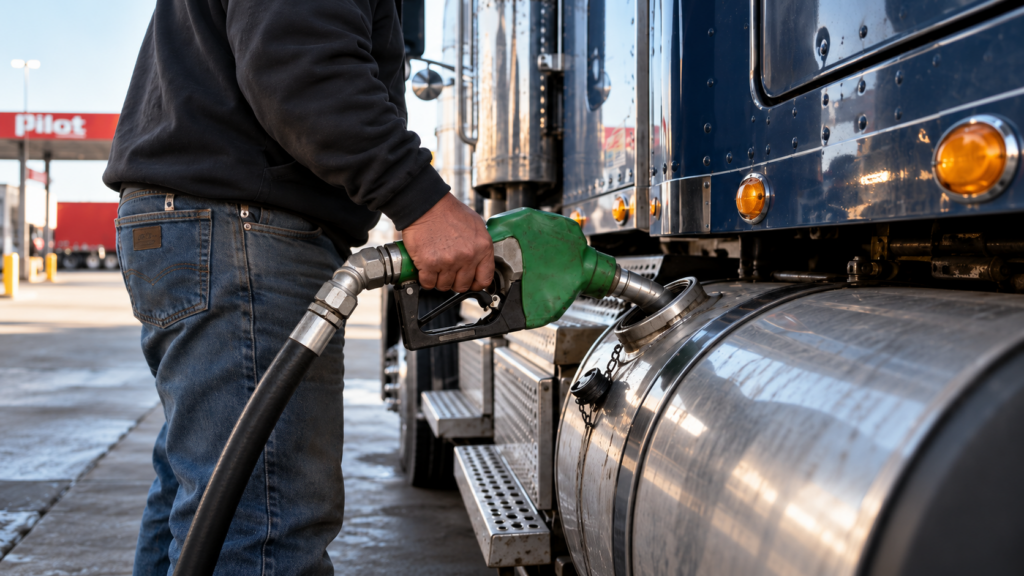
Diesel still runs about $2 a gallon above regular gasoline in Missouri this week for reasons that go beyond the crude oil market, the U.S. Energy Information Administration says, as Macon County farms, school buses, and trucks on U.S. 36 and U.S. 63 burn harvest-season fuel.
As the Chronicle reported Sept. 22, AAA's Missouri diesel average hit a recorded high of $6.3475 a gallon that Tuesday. By Friday, Sept. 25, the statewide diesel average was $6.3098, still well above the $4.1945 average for regular unleaded, according to AAA. The national diesel average was $6.5019 the same day.
The EIA's Midwest on-highway diesel series for the week of Sept. 21 stood at $6.68 a gallon in the agency's Gasoline and Diesel Fuel Update released Sept. 22.
The EIA says on-highway diesel has cost more than regular-grade gasoline, on a dollar-per-gallon basis, almost continuously since September 2004. The agency lists three lasting reasons: relatively high demand for diesel and other distillate fuels, the transition to cleaner lower-sulfur diesel, and a higher federal tax on highway diesel than on gasoline.
The federal tax on on-highway diesel is 24.40 cents a gallon, 6 cents higher than the federal tax on gasoline, according to the EIA. In the agency's January 2026 motor-fuel tax table, the federal total is 24.40 cents on diesel and 18.40 cents on gasoline.
Most highway diesel sold in the United States is ultra-low sulfur diesel, capped at 15 parts per million of sulfur under Environmental Protection Agency rules, the EIA says. The agency's diesel price FAQ says the move to less polluting, lower-sulfur diesel affected production and distribution costs.
Refineries also get less diesel from a barrel of crude than gasoline. U.S. refineries produce about 19 to 20 gallons of motor gasoline and 11 to 13 gallons of ultra-low sulfur distillate, most of it sold as diesel, from one 42-gallon barrel, according to the EIA. Scientific American, in a Sept. 24 article by Adam Kovac, reported the same yield gap and quoted Columbia University engineering professor Robert Farrauto on the high-pressure, high-temperature refining used to strip sulfur and metals from heavier crude streams that feed diesel production.
Demand keeps pressure on the market even when drivers cut back on gasoline trips. Diesel powers freight trucks, farm equipment, and other commercial engines, the EIA says, and demand generally tracks the economy. Heating oil and diesel are nearly the same distillate products, so winter heating demand can push diesel prices higher. In farm country, seasonal swings in growers' diesel use can also move prices, according to the agency.
Macon County counted 1,258 farms and 432,256 acres of land in farms in the 2022 Census of Agriculture, according to the U.S. Department of Agriculture's National Agricultural Statistics Service county profile. Soybeans for beans covered 101,939 acres. That mix of combines, grain trucks, school buses, emergency vehicles, and highway freight is why the gasoline-diesel spread shows up at harvest, not only at the pump.
Chariton Media Group sought comment Friday from University of Missouri Extension in Macon County, Presiding Commissioner Dean Still, and Macon County R-I Superintendent Bryan Thomsen about how higher diesel prices are affecting local harvest, county fleets, and school transportation. Chariton Media Group did not receive a response in time for publication.