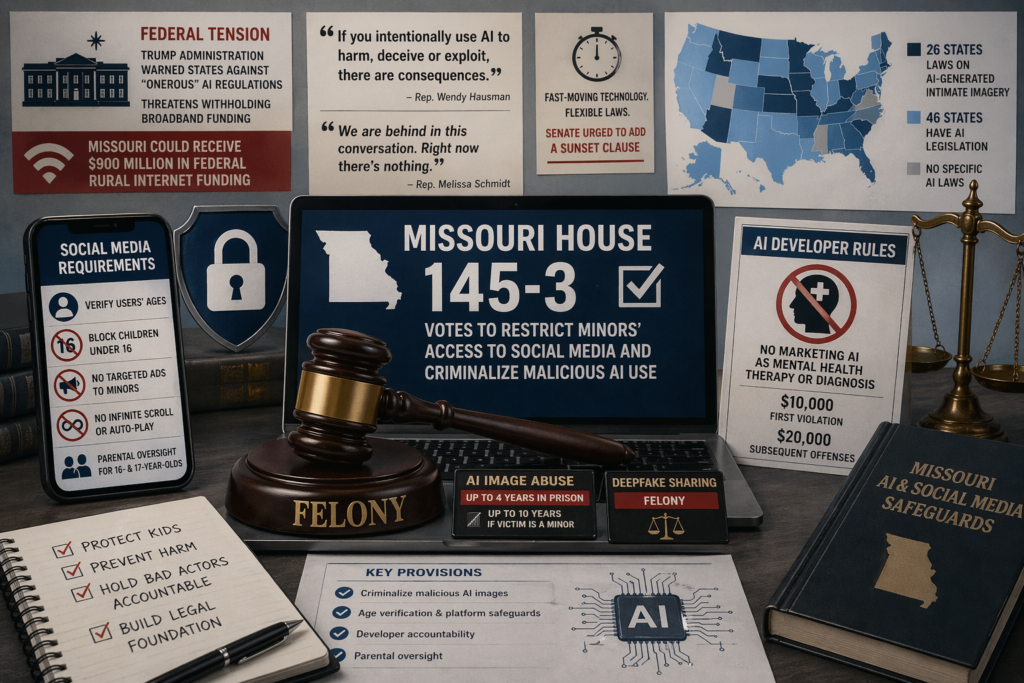
JEFFERSON CITY — The Missouri House voted overwhelmingly Monday to restrict minors’ access to social media and criminalize the malicious use of AI-generated images, advancing legislation to the Senate on a 145-3 vote.
The bill, sponsored by Rep. Wendy Hausman, R-St. Peters, consolidates proposals from at least 10 lawmakers and targets what Hausman called deliberate misuse of artificial intelligence.
“If you intentionally use AI to harm, deceive or exploit, there are consequences,” Hausman said.
Under the measure, sharing or threatening to share an AI-generated image to harass or harm someone would be a felony carrying up to four years in prison. The penalty increases to 10 years if the depicted person is a minor.
Social media platforms would be required to verify users’ ages and block children under 16 from creating accounts. Platforms could not target minors with paid advertising or design features such as infinite scroll or auto-playing content. Parents would retain oversight authority over accounts held by 16- and 17-year-olds.
AI developers would be barred from marketing their products as capable of providing mental health therapy or diagnoses, with fines of $10,000 for a first violation and $20,000 for subsequent offenses.
The bill’s passage comes as Missouri lawmakers navigate potential conflict with the Trump administration, which issued an executive order in January warning states against “onerous” AI regulations and threatening to withhold federal broadband funding from states that pass such laws. Missouri stands to receive $900 million in federal rural internet funding.
Sen. Joe Nicola, R-Grain Valley, said he is negotiating with the White House over a separate AI liability bill he sponsors. Nicola said provisions establishing deepfake sharing as a felony remain unchanged, though he is revising language on developer liability in response to federal feedback.
Sponsors acknowledged the legislation is a starting point. Rep. Melissa Schmidt, R-Eldridge, said lawmakers are determined to establish a legal foundation even if federal pressure requires adjustments.
“We are behind in this conversation,” Schmidt said. “Right now there’s nothing.”
Rep. Elizabeth Fuchs, D-St. Louis, voted for the bill but urged the Senate to add a sunset clause, citing the pace of AI development.
At least 26 states have enacted laws addressing AI-generated intimate imagery. Forty-six states have some form of AI legislation on the books.