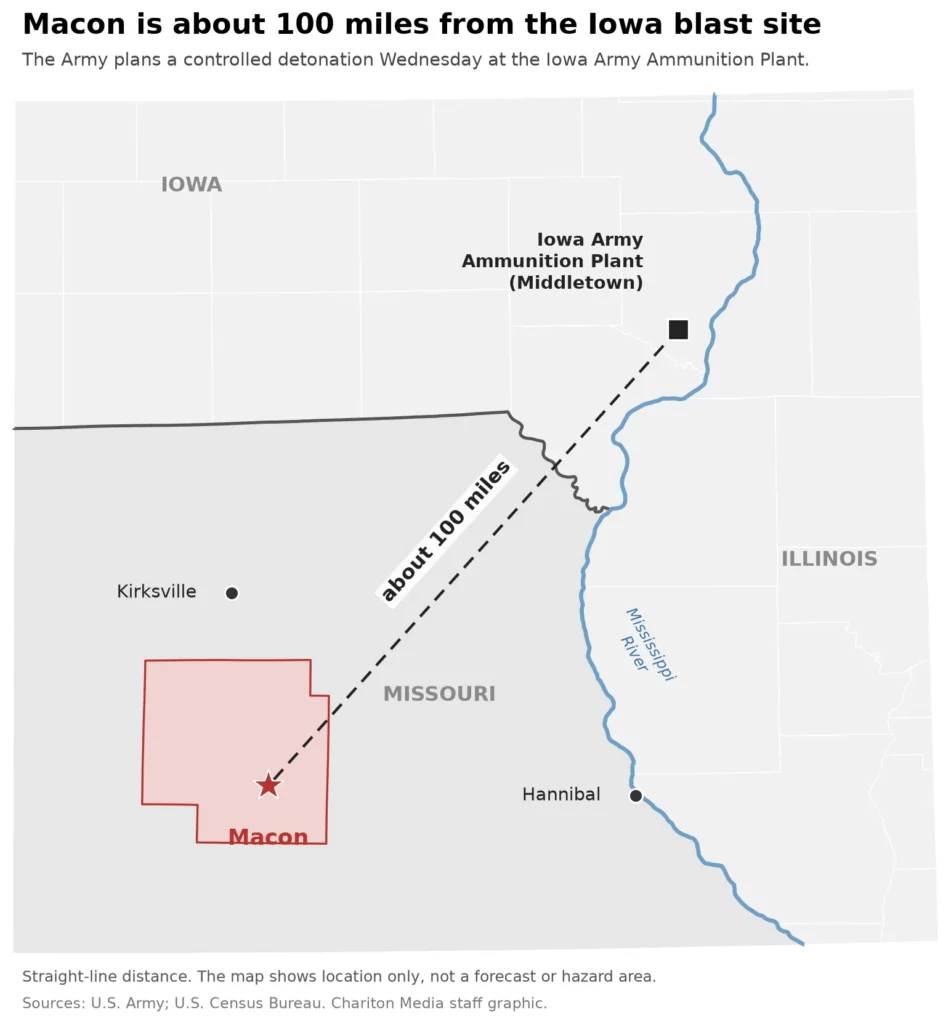
The U.S. Army plans to blow up nearly 9,800 pounds of deteriorated lead-based explosive at an Iowa ammunition plant Wednesday, a day forecasters expect light northeast winds there that would blow toward northeast Missouri.
The Army said in an update Sunday that the controlled detonation at the Iowa Army Ammunition Plant in Middletown, Iowa, "is now scheduled on Wednesday, November 25, 2026 to allow for more optimal weather conditions and all mitigation measures to be emplaced." It gave no time.
Macon is about 100 miles southwest of the plant. The National Weather Service forecast for the plant site, updated at 5:12 a.m. Monday, calls for a northeast wind around 5 mph Wednesday. A northeast wind blows toward the southwest.
No official estimate yet shows where lead from a Wednesday blast could go. Army maps issued Nov. 17 for the original Nov. 20 date showed airborne lead drifting north toward Iowa City and Cedar Rapids, away from Missouri. The Environmental Protection Agency’s emergency permit, now on hold, calls for an updated estimate no later than 48 hours before the blast and hourly updates starting six hours before. As of 9:45 a.m. Monday, no estimate for Wednesday had been posted on the Army’s notification page.
Officials caution that the maps are estimates. The Iowa Department of Health and Human Services said the Army’s maps "are modeled projections, not confirmed measurements, and may change based on weather conditions." The Army’s Nov. 18 advisory said modeling predicts lead in the air "may be elevated but well below the level at which EPA would require protective actions be taken."
Gov. Mike Kehoe activated a team of state agencies Nov. 20, when the blast was set for Monday.
"We are consulting with the National Weather Service, whose forecast calls for light winds out of the north for Monday, which should dramatically minimize risks through the air in northeast Missouri," Kehoe said then.
The state had not published an update for the Wednesday date as of Monday morning. The governor’s Nov. 20 release said "there is minimal risk to people outside of the detonation area" and that the Missouri Department of Health and Senior Services advises those concerned about exposure "to stay indoors as much as possible following detonation." The Department of Natural Resources is prepared to sample the Mississippi River and other surface drinking water sources, the release said.
The 8th U.S. Circuit Court of Appeals on Nov. 19 put the EPA permit on hold at the request of the Iowa Environmental Council and the Sierra Club. In a Nov. 21 notice, the Justice Department said the Army will act under an emergency exclusion in federal hazardous waste rules instead, arguing the order "does not enjoin or otherwise prohibit the Army from acting under a separate legal authority."
"We want to be absolutely clear that the regulation they cite is an extraordinary and extreme backstop for situations where there is truly nothing else that can be done," Rachel Rintelmann, a managing attorney at Earthjustice, which represents the groups, said in an email to CNN.
The government asked the court Sunday to lift its stay, CNN reported. No ruling had been reported as of Monday morning, according to Military.com.
The Army says the lead azide has formed crystals that could set off an uncontrolled explosion as temperatures fall. An Army ordnance commander’s sworn declaration said an April 28 inspection found deterioration in 58 of the 68 drums, Military.com reported.
The Army "intends to act consistent with the terms of the Emergency Permit and its mitigation measures even if not in effect," the Justice Department filing said. The permit calls for soil and surface sampling to start within 24 hours at parks, public facilities, and private properties whose owners have granted access in the area where modeling shows the most lead dust settling.
Iowa health officials advise people in potentially affected areas to keep windows and doors closed for 24 to 48 hours after the blast.